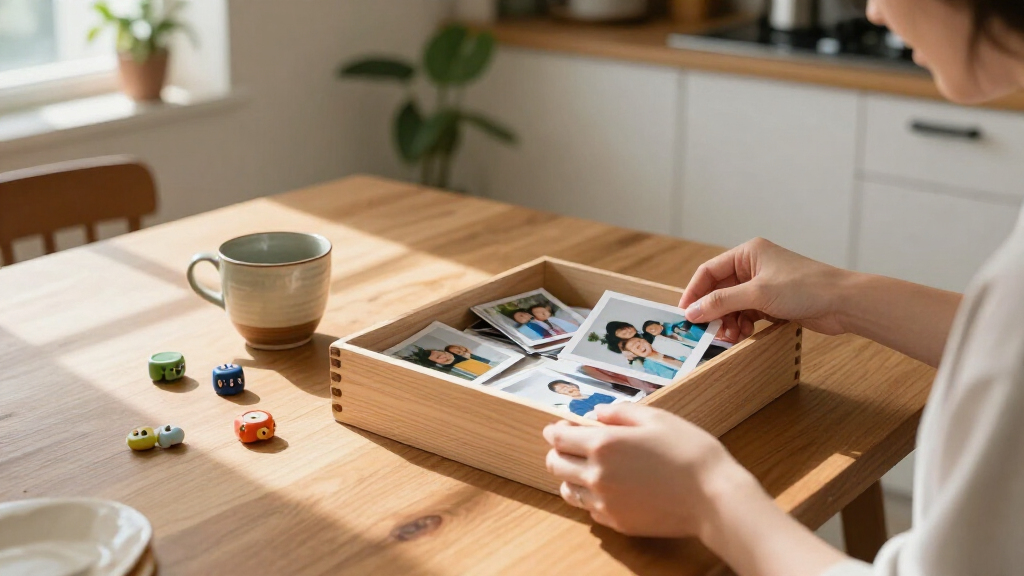

This checklist is for anyone hoping to keep family stories, everyday milestones, and meaningful moments close at hand. It brings together simple ways to preserve memories, from printed photographs and keepsakes to writing and reflection.

Get the little things that make your day delivered free with Prime
- Fast, free delivery on millions of items
- Prime Video, Amazon Music and more included
- Member-only deals all year
The sections follow different ways to save and display memories. Each one focuses on a product pick or, for the memory jar, practical advice without a specific product. Choose the format that fits how you like to revisit your memories.
Start with the memories you already have, then consider where they should live and who may want to see them. Use the look-for points as a checklist before buying, and check dimensions and compatibility details against your own needs.
Printed Photo Album
A printed album gives photographs a place to be revisited in sequence, whether you are gathering a trip, a family milestone, or a collection of images that matter to you. This pick is titled Photo‑Rich Companion Ranking 500 Landmark Albums with Essays and Archi; the listing title suggests a photo-rich companion with essays, but the supplied name does not establish its format, dimensions, or whether it is an album for adding your own prints. Confirm those basics before treating it as a personal photo album.
A common buying mistake is assuming that a book about landmark albums will hold loose photographs. Check the full product description for page type, binding, image content, and intended use. If your goal is to organize personal prints, verify that the pages accommodate their sizes and that the layout suits captions or dates. Consider how often you expect to handle it and where it will be stored; a large, heavy book may be less convenient to bring out regularly. Match the format to your purpose—reference and inspiration differ from a fillable album—and make sure the complete title and listing details match what you intend to buy.
What to look for:
- Confirm whether this is a reference book or an album for personal prints.
- Check the full title and product description for intended use.
- Verify dimensions and approximate weight for your shelf or table.
- Look for page and binding details in the listing.
- Confirm whether captions or dates can be added.
Photo‑Rich Companion Ranking 500 Landmark Albums with Essays and Archival Interv

This Rolling Stone companion presents a photo‑rich guide to five hundred landmark albums, offering insightful essays and archival interviews with the artists behind them. It serves as an essential reference for music enthusiasts seeking deep context and visual history of influential records.
Pros:
- Comprehensive coverage of 500 iconic albums
- Includes original essays and rare archival interviews
- Abundant high‑quality photographs enhance the reading experience
Cons:
- Large volume may be cumbersome to handle
- Potentially higher price point for a niche reference book
Best for: Readers seeking a photo-rich companion about landmark albums.
Not ideal for: Anyone who needs a confirmed, fillable album for personal prints.
Bottom line: Check the complete listing carefully to confirm this companion suits the kind of memory keeping you want.
Instant Camera
An instant camera can make a memory tangible soon after the moment happens, which may suit gatherings, trips, or small everyday rituals. The named pick is the Fujifilm Instax Mini EVO Hybrid Black Instant Camera with Twin Pack Fi. The supplied title identifies a hybrid camera and a twin pack, but it is truncated, so the exact film bundle and included accessories are unclear. Read the complete listing before relying on what comes in the box.
One common mistake is checking only that the camera uses instant film without confirming the specific film format and ongoing availability where you shop. Verify compatibility using the manufacturer’s product details, and check whether the listed twin pack is film or another bundled item. Consider how you plan to use the photos: confirm the camera’s features meet your needs, and whether prints will fit the album, frames, or storage you have in mind. Also check the camera’s dimensions and controls if portability or ease of use matters. Confirm the film format and bundle contents before pairing this pick with other keepsake supplies.
What to look for:
- Confirm the full model name and complete listing.
- Verify the compatible film format from product details.
- Check exactly what the twin pack includes.
- Compare print dimensions with your album or frame plans.
- Review camera dimensions and features for your intended use.
Fujifilm Instax Mini EVO Hybrid Black Instant Camera with Twin Pack Film, 32GB m

The Fujifilm Instax Mini EVO is a versatile hybrid instant camera offering 100 creative ways to capture photos with adjustable modes and effects. It features high-resolution printing, smartphone connectivity for easy editing and sharing, and comes with a twin pack of instant film, a 32GB microSD card, and a protective case.
Pros:
- Versatile with 100 creative modes and effects
- High-resolution instant prints at 600 DPI
- Smartphone connectivity for easy editing and printing
- Includes additional accessories like film, microSD card, and case
Cons:
- Requires smartphone app for full functionality
- Limited to Instax Mini film size
- Potentially complex for beginners
Best for: People who want a hybrid instant camera for making prints.
Not ideal for: Buyers who need bundle details or film compatibility confirmed from the supplied title alone.
Bottom line: Confirm the exact film format and included items before choosing this camera for your memory routine.
Archival Photo Box
A dedicated storage carton can help keep a group of photographs together and make it easier to find them later. This pick is titled Lineco Archival Storage Cartons, Acid-Free, 12x15x10 in, Tan, Pack of, which names an acid-free carton and gives dimensions, while leaving the pack quantity incomplete. Treat the measurements as listing information to verify, and compare them with the photographs or folders you plan to store.
A frequent mistake is buying based on the word “archival” without checking whether the interior dimensions suit the actual contents. Confirm the complete product details, the number of cartons included, and whether the measurements refer to the carton’s inside or outside. Leave enough room for photographs to sit without bending, and consider whether you will store prints flat or use protective sleeves. If you are grouping different sizes, plan a labeling approach so the box remains easy to navigate. Fit and quantity matter for practical organization: a carton that is too small can crowd contents, while a much larger one may make it harder to find a particular set. Keep the box in a location that works for your storage habits.
What to look for:
- Verify the full pack quantity in the listing.
- Check whether dimensions are interior or exterior.
- Measure photographs, folders, or sleeves before ordering.
- Confirm the carton’s intended storage use in product details.
- Plan labels or groupings for easy retrieval.
Lineco Archival Storage Cartons, Acid-Free, 12x15x10 in, Tan, Pack of 5

These acid-free, archival storage cartons are designed for preserving photos, documents, and artwork. Made from durable, lignin-free corrugated material, they feature a ready-to-assemble design with handles and a removable lid for convenient storage and transport.
Pros:
- Archival quality for long-term preservation
- Durable and strong with double-layered bottom
- Easy to assemble without tools
Cons:
- May be bulky for small storage needs
- Limited color options
Best for: People organizing prints in a carton with stated dimensions.
Not ideal for: Anyone whose photographs or folders do not fit the verified interior size.
Bottom line: Measure your materials and confirm the complete pack details before selecting this carton.
Decorative Picture Frames
Displaying photographs can make favorite memories part of the spaces you use every day. The named pick, QUTREY 20 Opening 4×6 Collage Picture Frame Set of 2, 18.1×41.3 inches, identifies two collage frames with twenty openings and 4×6 sizing. That gives you a starting point for planning which images to print and where the frames might go. Check the full listing for mounting details and what hardware is included.
A common mistake is choosing a frame by its overall dimensions without measuring the wall or checking how the openings are arranged. Confirm the frame’s finished dimensions, orientation, and whether the twenty openings are per frame or across the set. Make sure your photos are compatible with the stated 4×6 openings, and check whether mats affect the visible image area. Consider the weight and mounting method, especially if you are placing the frames above furniture or in a high-traffic area. Plan the wall and photo layout together: arrange candidate images before printing so the collage feels balanced and the sizes fit. Check the listing for frame materials and care instructions if those affect your preferences.
What to look for:
- Confirm whether twenty openings are per frame or for the set.
- Verify overall dimensions and intended orientation.
- Check compatibility with standard 4×6 prints and visible image area.
- Review included mounting hardware and installation details.
- Measure the wall space before choosing placement.
QUTREY 20 Opening 4×6 Collage Picture Frame Set of 2, 18.1×41.3 inches Black Mul

This set includes two black collage frames with 20 openings for 4×6 inch photos, perfect for displaying family, vacation, or art pictures. The frames feature a versatile design with easy-open tabs and can be hung vertically or horizontally.
Pros:
- Includes 2 frames with 20 openings for versatile photo display
- Easy to load photos with open tabs and simple installation
- Neutral black color complements many decor styles
- Can be hung vertically or horizontally
Cons:
- Large size may require ample wall space
- Frames are made of PS plastic, which may be less durable than wood
- Protection film on the front needs to be removed before use
Best for: People looking to arrange multiple 4×6 photos in collage frames.
Not ideal for: Anyone without enough wall space for the verified frame dimensions.
Bottom line: Confirm opening count, overall size, and mounting details, then choose photos that fit.
Memory Jar
A memory jar is a flexible, advice-only way to collect small moments over time. Use slips of paper for a sentence, a date, or a brief description of something you want to remember. The container can be one you already have; the useful part is making the practice easy to repeat. Keep the prompts simple, such as a moment that made you laugh or something you appreciated that day.
A common mistake is making the habit too elaborate or leaving notes without enough context to understand them later. Add a date or a few identifying details when helpful, and decide whether you want to read notes monthly, seasonally, or at year’s end. If several people contribute, consider using different paper colors or adding initials. Choose a container with an opening that fits your notes and a place where contributors will see it. Make access convenient while protecting private reflections if the jar will be shared. A small supply of slips and a pen beside it can remove friction and help the collection grow naturally.
What to look for:
- Choose a container with an opening that fits folded notes.
- Keep paper and a pen within easy reach.
- Add dates or brief context to notes when useful.
- Decide how often to read or sort the notes.
- Use initials or distinct paper if multiple people contribute.
Keepsake Journal
A guided journal can give reflection a regular place and offer prompts when it is hard to know where to begin. This pick is called Guided Bible Study and Prayer Journal with Scripture Prompts, so it is oriented toward Bible study and prayer rather than a general-purpose memory log. Consider whether that focus matches the kind of keepsake you want to create, and review the complete listing for its page layout and included prompts.
A common mistake is choosing a journal based on its title without checking whether the structure suits your writing habits. Look for the full description of prompt types, page format, and whether there is room for longer entries or dates. If you intend to record family memories alongside reflections, consider whether the prompts leave space for both. Check the journal’s dimensions and binding if you plan to carry it, store it on a shelf, or write in it often. Choose a guided format you will use: a focused devotional structure can be meaningful when it fits your routine, while someone seeking open-ended memory keeping may prefer a less directed notebook. Keep a pen nearby and set a comfortable cadence rather than aiming for perfect consistency.
What to look for:
- Confirm the journal’s complete title and focus.
- Review the types of Scripture prompts included.
- Check page layout and space for longer entries.
- Verify journal dimensions and binding style.
- Consider whether the prompts fit your memory-keeping purpose.
Guided Bible Study and Prayer Journal with Scripture Prompts

This refillable leather journal provides structured space for scripture, takeaways, gratitude, prayers, and reflections across daily, weekly, and monthly prompts. It features 100 gsm pages, a magnetic strap, scripture-inspired artwork, and gift-ready packaging in a matte black box.
Pros:
- Guided prompts provide space for scripture, gratitude, prayer, and reflection.
- Refillable design supports continued use.
- Leather cover, fine stitching, and magnetic strap offer a durable, polished finish.
- 100 gsm pages are designed to resist bleed-through.
Cons:
- Binding type is unspecified.
- The journal is designed around Christian scripture and devotional practice.
Best for: People who want Bible study and prayer prompts in a keepsake journal.
Not ideal for: Writers looking for an open-ended, general memory book.
Bottom line: Choose this journal if its devotional prompts and layout fit the reflections you want to preserve.
Build your checklist in a practical order: first decide which memories need a home, then choose a format, and finally confirm dimensions, compatibility, and listing details. Prioritize the basics you will use—a suitable place for prints, a way to display favorites, or a simple writing habit—before adding more pieces.
Memory keeping can be small and personal: one labeled box, a few framed photos, or a note written when a moment feels worth saving. Start with the option that fits your routine and let the collection grow at its own pace. Meaning comes from returning to the memories, not from having a perfect system.