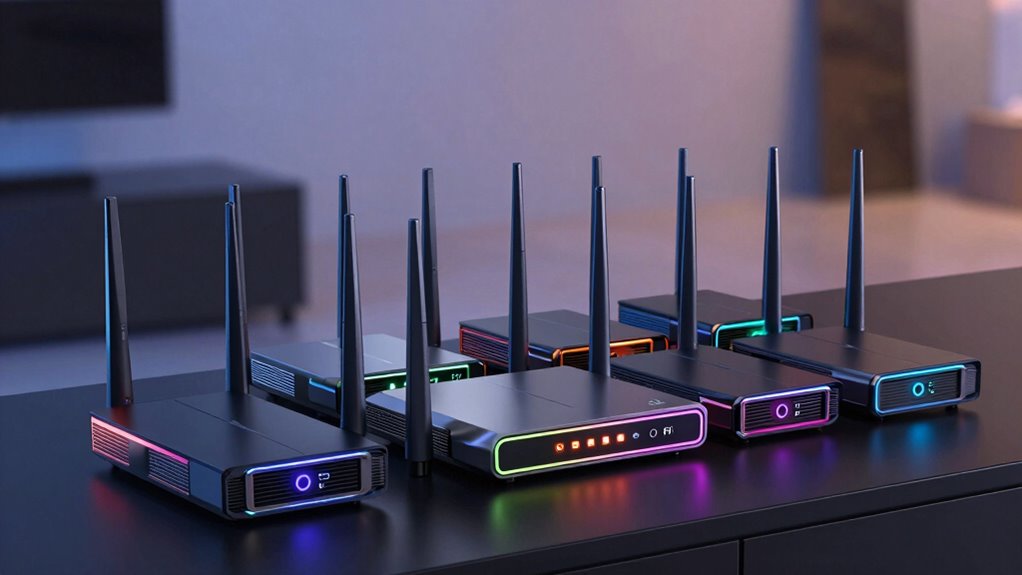

For most homes, I would start with the TP-Link Archer BE550: its tri-band design gives it more flexibility than the many dual-band choices here. The ASUS ROG Rapture GT-BE98 Pro is the standout for demanding gaming setups, while the TP-Link Deco 7 family suits buyers who need mesh coverage rather than one powerful router. The main tradeoff is paying for extra bands, ports, or mesh nodes only when your home and devices can make use of them. A Wi-Fi 7 label alone does not promise better coverage, and older devices will not gain Wi-Fi 7 features. Read on for how these 14 routers differ and which buyer each one fits.

Get the little things that make your day delivered free with Prime
- Fast, free delivery on millions of items
- Prime Video, Amazon Music and more included
- Member-only deals all year
Key Takeaways
- Tri-band separates flexible routers from basic upgrades: the Archer BE550, Archer BE600, ASUS RT-BE82U, and several Nighthawk models offer more band capacity than the dual-band options, though the benefit depends on device mix and network traffic.
- Mesh solves a different problem from a standalone router: eero 7 and the Deco systems are aimed at spreading coverage across a home, not simply maximizing one router’s feature list.
- The GT-BE98 Pro is the specialist pick: its quad-band design targets demanding gaming and busy networks, but most homes do not need that much hardware.
- The lineup spans simple to feature-heavy: eero 7 emphasizes an approachable mesh setup, while ASUS and Nighthawk options suit buyers more interested in router controls and advanced capability.
- Model details matter more than the Wi-Fi 7 label: band count, wired ports, coverage plans, and whether a unit is refurbished can change the fit more than the generation name.
| eero 7 Dual-Band Mesh Wi-Fi 7 Router (1-Pack) |  | Best Simple Wi-Fi 7 Entry Point | Wi-Fi standard: Wi-Fi 7 | Bands: Dual-band | Maximum internet speed: 2.5 Gbps | VIEW ON AMAZON | See Our Full Breakdown |
| TP-Link Deco 7 BE5000 Dual-Band Wi-Fi 7 Mesh System |  | Best Value for Wide-Area Mesh | Wi-Fi standard: Wi-Fi 7 | Bands: Dual-band, 2.4 GHz and 5 GHz | Maximum combined speed: Up to 5 Gbps | VIEW ON AMAZON | See Our Full Breakdown |
| TP-Link Archer BE600 Tri-Band Wi-Fi 7 Router (BE9700) |  | Best for Multi-Gig Wired Setups | Wi-Fi standard: Wi-Fi 7 | Bands: Tri-band: 6 GHz, 5 GHz, and 2.4 GHz | Maximum combined bandwidth: 9.7 Gbps | VIEW ON AMAZON | See Our Full Breakdown |
| ASUS RT-BE82U WiFi 7 Router |  | Best for Wired Multi-Gig Homes | Model: RT-BE82U | Wi-Fi standard: Wi-Fi 7 (802.11be) | Bands: Dual-band | VIEW ON AMAZON | See Our Full Breakdown |
| Deco 7 Pro Tri-Band WiFi 7 Whole Home Mesh System (6-Stream, 10 Gbps) |  | Best for Large Homes and Heavy Device Loads | Wi-Fi standard: Wi-Fi 7 | Bands: Tri-band | Band speeds: 6 GHz: 5,188 Mbps; 5 GHz: 4,324 Mbps; 2.4 GHz: 574 Mbps | VIEW ON AMAZON | See Our Full Breakdown |
| TP-Link Archer BE400 Wi-Fi 7 Router (BE6500) |  | Best Value for Multi-Gig Wired Connections | Wi-Fi standard: Wi-Fi 7 (BE6500) | Bands: Dual-band: 2.4 GHz and 5 GHz | Maximum wireless speed: 6.5 Gbps total | VIEW ON AMAZON | See Our Full Breakdown |
| TP-Link Archer BE230 Dual-Band Wi-Fi 7 Router |  | Best for Straightforward Wi-Fi 7 Upgrades | Wi-Fi standard: Wi-Fi 7 (802.11be) | Bands: Dual-band: 2.4 GHz and 5 GHz | Maximum wireless speed: 2,882 Mbps on 5 GHz and 688 Mbps on 2.4 GHz | VIEW ON AMAZON | See Our Full Breakdown |
| NETGEAR Nighthawk WiFi 7 Router RS90 |  | Best for Simple Nighthawk App Management | Model: RS90 | Wi-Fi standard: Wi-Fi 7 | Bands: Dual-band: 2.4 GHz and 5 GHz | VIEW ON AMAZON | See Our Full Breakdown |
| NETGEAR Nighthawk WiFi 7 Router RS140, Up to 2,250 sq ft, 5 Gbps |  | Best for Higher Listed Capacity in a Dual-Band Nighthawk | Wi-Fi standard: Wi-Fi 7 | Bands: Dual-band | Maximum wireless speed: Up to 5 Gbps | VIEW ON AMAZON | See Our Full Breakdown |
| ASUS ROG Rapture GT-BE98 Pro Quad-Band WiFi 7 Gaming Router |  | Best Premium Pick for Gaming and Multi-Gig Setups | Wi-Fi standard: Wi-Fi 7 (802.11be) | Bands: Quad-band, including dual 6 GHz bands | Maximum data transfer rate: Up to 30 Gbps | VIEW ON AMAZON | See Our Full Breakdown |
| NETGEAR Nighthawk RS300 Tri-Band WiFi 7 Router (Certified Refurbished) |  | Best Refurbished Tri-Band Pick | WiFi standard: WiFi 7 (802.11ax) | Bands: Tri-band, including 6 GHz | Maximum speed: Up to 9.3 Gbps | VIEW ON AMAZON | See Our Full Breakdown |
| NETGEAR Nighthawk BE9300 WiFi 7 Router |  | Best for Busy Homes | WiFi standard: WiFi 7 | Bands: Tri-band: 2.4 GHz, 5 GHz, 6 GHz | Maximum speed: Up to 9.3 Gbps | VIEW ON AMAZON | See Our Full Breakdown |
| NETGEAR Nighthawk WiFi 7 Router RS700S |  | Best Premium High-Capacity Router | WiFi standard: WiFi 7 | Bands: Tri-band: 2.4 GHz, 5 GHz, 6 GHz | Maximum speed: Up to 19 Gbps | VIEW ON AMAZON | See Our Full Breakdown |
| TP-Link Archer BE550 Tri-Band Wi-Fi 7 Router |  | Best for Multi-Gig Wired Homes | Wi-Fi standard: Wi-Fi 7 | Bands: Tri-band: 6 GHz, 5 GHz, 2.4 GHz | Maximum combined speed: Up to 9.2 Gbps | VIEW ON AMAZON | See Our Full Breakdown |
| wifi 7 router | Bands | Wi-Fi standard | Coverage |
|---|---|---|---|
| eero 7 Dual-Band Mesh Wi-Fi 7 | Dual-band | Wi-Fi 7 | Up to 2,000 sq. ft. |
| TP-Link Deco 7 BE5000 Dual-Ban | Dual-band, 2.4 GHz and 5 GHz | Wi-Fi 7 | Up to 6,600 sq. ft. |
| TP-Link Archer BE600 Tri-Band | Tri-band: 6 GHz, 5 GHz, and 2.4 GHz | Wi-Fi 7 | Up to 2,600 sq. ft. |
| ASUS RT-BE82U WiFi 7 Router | Dual-band | Wi-Fi 7 (802.11be) | — |
| Deco 7 Pro Tri-Band WiFi 7 Who | Tri-band | Wi-Fi 7 | Up to 7,600 sq. ft. (three-pack) |
| TP-Link Archer BE400 Wi-Fi 7 R | Dual-band: 2.4 GHz and 5 GHz | Wi-Fi 7 (BE6500) | Up to 2,400 sq. ft. |
| TP-Link Archer BE230 Dual-Band | Dual-band: 2.4 GHz and 5 GHz | Wi-Fi 7 (802.11be) | — |
| NETGEAR Nighthawk WiFi 7 Route | Dual-band: 2.4 GHz and 5 GHz | Wi-Fi 7 | — |
| NETGEAR Nighthawk WiFi 7 Route | Dual-band | Wi-Fi 7 | Up to 2,250 sq. ft. |
| ASUS ROG Rapture GT-BE98 Pro Q | Quad-band, including dual 6 GHz bands | Wi-Fi 7 (802.11be) | — |
| NETGEAR Nighthawk RS300 Tri-Ba | Tri-band, including 6 GHz | — | Up to 2,500 sq. ft. |
| NETGEAR Nighthawk BE9300 WiFi | Tri-band: 2.4 GHz, 5 GHz, 6 GHz | — | Up to 2,500 sq. ft. |
| NETGEAR Nighthawk WiFi 7 Route | Tri-band: 2.4 GHz, 5 GHz, 6 GHz | — | Up to 3,500 sq. ft. |
| TP-Link Archer BE550 Tri-Band | Tri-band: 6 GHz, 5 GHz, 2.4 GHz | Wi-Fi 7 | — |
More Details on Our Top Picks
eero 7 Dual-Band Mesh Wi-Fi 7 Router (1-Pack)
I’d choose the eero 7 for a medium-sized home that needs straightforward Wi-Fi 7 coverage rather than the highest peak speeds. Its TrueMesh software is designed to reduce dead spots, and a single unit covers up to 2,000 square feet while supporting more than 120 devices. Two 2.5 GbE ports also give you room for a fast internet connection or wired device. Compared with the TP-Link Archer BE600, this is a simpler dual-band option with lower stated wireless speed and fewer connectivity extras; the BE600 is a better fit for buyers seeking tri-band capacity and more multi-gigabit ports. The eero’s tradeoff is its single-unit coverage limit: larger homes may need additional eero units, and dual-band hardware has less room to separate busy traffic.
Pros:- TrueMesh software is designed to help reduce dead spots.
- Rated to cover up to 2,000 square feet and support more than 120 devices.
- Two 2.5 GbE auto-sensing ports support multi-gigabit wired connections.
- Three-year warranty and compatibility with previous eero generations and Amazon Echo devices.
Cons:- A single unit’s stated coverage may not suit larger homes without additional units.
- Dual-band design has less capacity for separating traffic than a tri-band router such as the TP-Link Archer BE600.
- Maximum stated wireless speed is 1.8 Gbps, lower than the faster options in this roundup.
Best for: Households seeking an easy-to-manage Wi-Fi 7 router for a medium-sized home with many smart devices and no need for top-end tri-band speeds.
Not ideal for: Owners of large or multi-story homes who need broad coverage from one router, or buyers prioritizing tri-band capacity and higher peak wireless bandwidth.
- Wi-Fi standard:Wi-Fi 7
- Bands:Dual-band
- Maximum internet speed:2.5 Gbps
- Maximum wireless speed:1.8 Gbps
- Coverage:Up to 2,000 sq. ft.
- Device capacity:More than 120 devices
- Ports:2 × 2.5 GbE auto-sensing
- Warranty:3 years
Our verdict“Choose the eero 7 for uncomplicated Wi-Fi 7 coverage in a medium-sized home, but look at the Archer BE600 if you need tri-band performance.”
TP-Link Deco 7 BE5000 Dual-Band Wi-Fi 7 Mesh System
The Deco 7 BE5000 makes the most sense when one router cannot reach the whole home and mesh coverage matters more than a single unit’s peak performance. Its stated coverage reaches 6,600 square feet, with support for more than 150 devices, and wired or wireless backhaul gives you options for linking Deco units. AI-assisted roaming helps devices move between nodes as people travel around the home. Compared with the Deco 7 Pro, this is the more restrained dual-band choice: the Pro adds a 6 GHz band and higher device capacity, while the BE5000’s broad coverage can suit homes that do not need that extra band. This is a system, not a modem, so you’ll need a separate modem and at least two Deco units for mesh backhaul. Actual coverage also depends on walls, placement, and layout.
Pros:- Rated to cover up to 6,600 square feet across the system.
- Supports more than 150 devices.
- Offers both wired and wireless backhaul options.
- Includes AI-assisted roaming, VPN connections, app management, and basic HomeShield security features.
Cons:- Requires a separate modem for internet access.
- Mesh backhaul requires at least two Deco units.
- Dual-band design lacks the 6 GHz band found on the Deco 7 Pro.
Best for: Families in large homes who want mesh coverage for many connected devices and can connect the system to an existing modem.
Not ideal for: Buyers who want a single standalone router, need a built-in modem, or want tri-band 6 GHz capacity for demanding nearby devices.
- Wi-Fi standard:Wi-Fi 7
- Bands:Dual-band, 2.4 GHz and 5 GHz
- Maximum combined speed:Up to 5 Gbps
- 5 GHz speed:Up to 4,324 Mbps
- 2.4 GHz speed:Up to 688 Mbps
- Coverage:Up to 6,600 sq. ft.
- Supported devices:More than 150
- Backhaul:Wired or wireless; at least two Deco units required
- Modem:Separate modem required
Our verdict“Pick the Deco 7 BE5000 for broad mesh coverage on a dual-band system, but choose the Deco 7 Pro if 6 GHz capacity is a priority.”
TP-Link Archer BE600 Tri-Band Wi-Fi 7 Router (BE9700)
I’d put the Archer BE600 high on the list for a home that combines newer Wi-Fi devices with several fast wired connections. Its tri-band Wi-Fi 7 setup offers a stated 9.7 Gbps combined bandwidth, including 6 GHz, while its port mix stands out: one 10 Gbps WAN/LAN port and four 2.5 Gbps ports. That gives a home with multi-gig internet, a wired workstation, and other high-bandwidth devices more direct connection options than the ASUS RT-BE82U, which has five 2.5 GbE ports but no listed 10 Gbps port. The BE600 also adds USB 3.0, VPN support, and app or web management. Its tradeoff is that it is still a single router rated for up to 2,600 square feet, not a wide-area mesh system like the Deco 7 BE5000.
Pros:- Tri-band Wi-Fi 7 with a stated combined bandwidth of up to 9.7 Gbps.
- One 10 Gbps WAN/LAN port and four 2.5 Gbps ports support fast wired networking.
- Includes USB 3.0, VPN client and server support, and parental controls.
- Coverage is rated for up to 2,600 square feet and up to 120 devices.
Cons:- A single router may not reach throughout a large or complex home as well as a mesh system.
- Real coverage and speeds vary with placement, walls, and client-device capability.
- Some advanced features require compatible devices or app-based setup.
Best for: Households with multi-gig internet, Wi-Fi 7 devices, and several wired devices that benefit from 10 Gbps or 2.5 Gbps Ethernet.
Not ideal for: People who need mesh coverage across a very large home or whose devices and internet plan do not make use of tri-band and multi-gigabit connections.
- Wi-Fi standard:Wi-Fi 7
- Bands:Tri-band: 6 GHz, 5 GHz, and 2.4 GHz
- Maximum combined bandwidth:9.7 Gbps
- Maximum band speeds:6 GHz: 5,765 Mbps; 5 GHz: 2,882 Mbps; 2.4 GHz: 1,032 Mbps
- Coverage:Up to 2,600 sq. ft.
- Maximum devices:Up to 120
- Ethernet ports:1 × 10 Gbps WAN/LAN; 1 × 2.5 Gbps WAN/LAN; 3 × 2.5 Gbps LAN
- USB:USB 3.0
- Management:TP-Link Tether app or web interface
Our verdict“Choose the Archer BE600 if multi-gig wired ports and tri-band Wi-Fi matter more than mesh coverage across a large home.”
ASUS RT-BE82U WiFi 7 Router
The ASUS RT-BE82U is a practical match for buyers who want Wi-Fi 7 alongside a generous set of wired connections. Its five 2.5 GbE ports can accommodate several high-speed wired devices without leaning on a separate multi-gig switch, while AiMesh provides a way to expand coverage with compatible ASUS equipment. AiProtection Pro adds built-in network security. Compared with the TP-Link Archer BE600, the RT-BE82U is dual-band rather than tri-band and does not list a 10 Gbps Ethernet port; the Archer is the stronger fit for buyers who want a dedicated 6 GHz band and faster wired uplink options. The ASUS instead offers a straightforward five-port 2.5 GbE layout. Its stated 6.5 Gbps speed is best treated as a capability ceiling: compatible Wi-Fi 7 clients are needed to reach the newer standard’s benefits.
Pros:- Five 2.5 GbE ports support multiple wired multi-gig devices.
- AiMesh support allows expansion with compatible ASUS routers.
- AiProtection Pro provides built-in network security.
- Supports Wi-Fi 7 features including Multi-Link Operation.
Cons:- Dual-band design lacks the 6 GHz band offered by the tri-band Archer BE600.
- No 10 Gbps Ethernet port is listed, unlike the Archer BE600.
- Wi-Fi 7 speed benefits depend on compatible client devices.
Best for: Homes with several wired multi-gig devices that want built-in security and the option to extend coverage through ASUS AiMesh.
Not ideal for: Buyers who need tri-band 6 GHz Wi-Fi, a 10 Gbps Ethernet port, or the broadest mesh coverage out of the box.
- Model:RT-BE82U
- Wi-Fi standard:Wi-Fi 7 (802.11be)
- Bands:Dual-band
- Maximum speed:Up to 6,500 Mbps
- Ethernet ports:5 × 2.5 GbE
- Security:AiProtection Pro (Trend Micro)
- Mesh support:AiMesh
- Other features:Multi-Link Operation; VPN compatible
Our verdict“Choose the RT-BE82U if you need five 2.5 GbE ports and ASUS AiMesh, but favor the Archer BE600 for tri-band Wi-Fi and a 10 Gbps port.”
Deco 7 Pro Tri-Band WiFi 7 Whole Home Mesh System (6-Stream, 10 Gbps)
For a large home with many simultaneous connections, the Deco 7 Pro combines mesh coverage with tri-band Wi-Fi 7 instead of asking a single router to reach every room. The three-pack is rated for up to 7,600 square feet and more than 200 devices, while the 6 GHz band adds capacity for compatible newer clients. Four 2.5 G WAN/LAN ports and USB 3.0 also give the system useful wired options. Compared with the dual-band Deco 7 BE5000, the Pro adds 6 GHz and supports more devices, making it the better match for a busy, high-demand household; the BE5000 remains the more restrained choice when its coverage and device capacity are enough. This system requires a separate modem and at least two Deco units for backhaul. Its listed coverage and speeds can also fall with distance, walls, and interference.
Pros:- Three-pack coverage is rated for up to 7,600 square feet.
- Supports more than 200 devices and includes a 6 GHz band.
- Four 2.5 G WAN/LAN ports and USB 3.0 provide wired connectivity options.
- Includes AI-driven roaming, HomeShield security, parental controls, IoT protection, and VPN client support.
Cons:- Requires a separate modem for internet access.
- At least two Deco units are needed for mesh backhaul.
- Coverage and performance vary with distance, walls, and interference.
Best for: Large households with many connected devices that want multi-node coverage, tri-band Wi-Fi 7, and several 2.5 G wired connections.
Not ideal for: Smaller homes that do not need a multi-unit mesh system, or buyers seeking an all-in-one modem-router setup.
- Wi-Fi standard:Wi-Fi 7
- Bands:Tri-band
- Band speeds:6 GHz: 5,188 Mbps; 5 GHz: 4,324 Mbps; 2.4 GHz: 574 Mbps
- Coverage:Up to 7,600 sq. ft. (three-pack)
- Supported devices:More than 200
- WAN/LAN ports:Four 2.5 G ports
- USB:USB 3.0
- Backhaul:At least two Deco units required
- Security:HomeShield, parental controls, IoT protection, and VPN client
Our verdict“Choose the Deco 7 Pro for large, device-heavy homes that need tri-band mesh coverage, and pick the Deco 7 BE5000 if dual-band capacity is sufficient.”
TP-Link Archer BE400 Wi-Fi 7 Router (BE6500)
I’d put the Archer BE400 near the top for buyers who want Wi-Fi 7 alongside useful wired capacity, without stepping up to a quad-band gaming router. Its two 2.5 Gbps ports can serve a multi-gig internet connection and a compatible wired device, while EasyMesh offers a way to extend coverage later. Compared with the Archer BE230, the BE400 lists higher maximum wireless throughput and coverage for a larger area, making it a better fit for busier or more spacious homes. The tradeoff is that both are dual-band: neither has the 6 GHz band available on tri-band Wi-Fi 7 options such as the Archer BE600. Also, EasyMesh does not make it compatible with TP-Link Deco systems, so check your mesh plans before choosing it.
Pros:- Two 2.5 Gbps ports allow multi-gig WAN service and a fast wired connection
- Higher listed maximum wireless speed and coverage than the Archer BE230
- Multi-Link Operation supports lower-latency connections with compatible devices
- WPA3, HomeShield, and EasyMesh add security and expansion options
Cons:- Dual-band design lacks the 6 GHz band found on tri-band Wi-Fi 7 routers
- EasyMesh compatibility does not extend to TP-Link Deco systems
- Requires a separate modem for internet service
Best for: Households with a multi-gig internet plan, a wired gaming PC or NAS, and a preference for TP-Link EasyMesh expansion
Not ideal for: Buyers who want a 6 GHz band or plan to build around TP-Link Deco mesh units
- Wi-Fi standard:Wi-Fi 7 (BE6500)
- Bands:Dual-band: 2.4 GHz and 5 GHz
- Maximum wireless speed:6.5 Gbps total
- Coverage:Up to 2,400 sq. ft.
- Device capacity:Up to 90 devices
- Ethernet ports:1× 2.5 Gbps WAN/LAN, 1× 2.5 Gbps LAN, 3× 1 Gbps LAN
- Mesh compatibility:EasyMesh; not compatible with Deco
- Security:WPA3, HomeShield, SPI Firewall
Our verdict“Choose the BE400 if you want two 2.5 Gbps ports and broader listed coverage, but skip it if 6 GHz or Deco compatibility is a priority.”
TP-Link Archer BE230 Dual-Band Wi-Fi 7 Router
The Archer BE230 is a sensible entry point for someone replacing an older router who wants Wi-Fi 7 features and straightforward app management. Multi-Link Operation and 4K-QAM are designed to improve how compatible devices use the available wireless connection, while the 2.5 Gbps WAN/LAN port avoids limiting a faster internet plan to a gigabit connection. Its listed 2,000-square-foot coverage is a step below the Archer BE400’s 2,400 square feet, and its 5 GHz maximum is lower too; in exchange, it still offers a 2.5 Gbps LAN port and EasyMesh support. The central limitation is shared with the BE400: this is a dual-band Wi-Fi 7 router, not a 6 GHz model. I’d skip it if adding that band is the main reason for upgrading.
Pros:- Multi-Link Operation and 4K-QAM bring Wi-Fi 7 features to a simple home-router setup
- 2.5 Gbps WAN/LAN and 2.5 Gbps LAN ports support multi-gig connections
- Tether app and EasyMesh support make setup and later coverage expansion easier
- Listed coverage and device capacity suit many midsize households
Cons:- No 6 GHz band, unlike tri-band Wi-Fi 7 options such as the Archer BE600
- Lower listed speed and coverage than the Archer BE400
- A separate modem is needed for internet service
Best for: First-time Wi-Fi 7 buyers in an apartment or midsize home who want app setup, EasyMesh support, and one multi-gig wired connection
Not ideal for: Owners of many 6 GHz-capable devices or people needing more coverage and wireless headroom than a dual-band router provides
- Wi-Fi standard:Wi-Fi 7 (802.11be)
- Bands:Dual-band: 2.4 GHz and 5 GHz
- Maximum wireless speed:2,882 Mbps on 5 GHz and 688 Mbps on 2.4 GHz
- Coverage and device capacity:Up to 2,000 sq. ft.; up to 60 devices
- Processor:Quad-core 2.0 GHz
- Ethernet ports:1× 2.5 Gbps WAN/LAN, 1× 2.5 Gbps LAN, 3× 1 Gbps LAN
- Mesh compatibility:EasyMesh
- Management and security:Tether app and TP-Link HomeShield
Our verdict“Pick the BE230 for an approachable dual-band Wi-Fi 7 upgrade with multi-gig Ethernet, not for 6 GHz access or maximum wireless capacity.”
NETGEAR Nighthawk WiFi 7 Router RS90
The Nighthawk RS90 suits buyers who want a Wi-Fi 7 router managed through NETGEAR’s app and do not need a large collection of multi-gig wired ports. Its 2.5 Gig WAN port can pair with a multi-gig internet plan, while four gigabit LAN ports handle ordinary wired devices. Against the TP-Link Archer BE230, the RS90 lists a higher total wireless speed, but its published device capacity is lower and it has only one stated multi-gig port. Both are dual-band models, so neither provides a 6 GHz band; buyers seeking that extra band should look at tri-band options in the roundup instead. NETGEAR Armor is another tradeoff: the supplied information describes a 30-day trial followed by a paid subscription. Coverage figures are estimates, and walls or interference can reduce the usable area.
Pros:- Listed maximum wireless speed of 3.6 Gbps
- 2.5 Gig WAN port supports a multi-gig internet connection
- Four gigabit LAN ports provide wired connections for home devices
- Nighthawk app supports setup and network management
Cons:- Dual-band design does not include a 6 GHz band
- Only one 2.5 Gig port is listed, unlike the Archer BE400’s two
- NETGEAR Armor moves to a paid subscription after its 30-day trial
Best for: Households that want Wi-Fi 7, a multi-gig WAN connection, and network management through the Nighthawk app
Not ideal for: Homes with many wired multi-gig devices, a high count of connected devices, or a requirement for 6 GHz Wi-Fi
- Model:RS90
- Wi-Fi standard:Wi-Fi 7
- Bands:Dual-band: 2.4 GHz and 5 GHz
- Maximum wireless speed:Up to 3.6 Gbps
- Coverage and device capacity:Up to 2,000 sq. ft.; up to 50 devices
- WAN port:1× 2.5 Gig Ethernet
- LAN ports:4× 1 Gig Ethernet
- Compatibility and management:Cable, fiber, DSL, and satellite; Nighthawk app
Our verdict“Choose the RS90 for app-led Wi-Fi 7 management and a 2.5 Gig WAN port, but look elsewhere for 6 GHz or multiple multi-gig wired connections.”
NETGEAR Nighthawk WiFi 7 Router RS140, Up to 2,250 sq ft, 5 Gbps
The Nighthawk RS140 is the stronger fit than the RS90 for households that expect more connected devices or want more listed wireless headroom while staying with a dual-band Nighthawk. NETGEAR specifies up to 5 Gbps and 80 devices, compared with the RS90’s 3.6 Gbps and 50-device capacity. That makes the RS140 a better match on paper for a busy household, though those figures do not promise that every device will reach peak speeds at once. Its wired setup is less generous than the Archer BE400: it has one 2.5 Gig WAN port and three gigabit LAN ports, rather than two 2.5 Gbps ports. Like the RS90 and TP-Link Archer BE230, it also omits 6 GHz. Armor security is offered as a 30-day trial, then requires a paid subscription.
Pros:- Listed maximum wireless speed reaches 5 Gbps
- Supports up to 80 devices, more than the RS90’s listed 50
- 2.5 Gig WAN port accommodates multi-gig internet service
- Nighthawk app provides mobile setup and management
Cons:- Dual-band Wi-Fi lacks a 6 GHz radio
- Three gigabit LAN ports do not provide multi-gig wired connections
- NETGEAR Armor requires a paid subscription after its 30-day trial
Best for: Busy households wanting higher listed device capacity and wireless speed than the RS90, with one multi-gig internet connection
Not ideal for: Buyers needing several multi-gig wired ports, a 6 GHz band, or security features without a post-trial subscription
- Wi-Fi standard:Wi-Fi 7
- Bands:Dual-band
- Maximum wireless speed:Up to 5 Gbps
- Coverage:Up to 2,250 sq. ft.
- Supported devices:Up to 80
- WAN port:1× 2.5 Gigabit Ethernet
- LAN ports:3× 1 Gigabit Ethernet
- Management and security:Nighthawk app; NETGEAR Armor 30-day free trial
Our verdict“The RS140 is the Nighthawk pick for a busier household that wants more listed speed and device capacity than the RS90, but not 6 GHz or multi-gig LAN ports.”
ASUS ROG Rapture GT-BE98 Pro Quad-Band WiFi 7 Gaming Router
The ROG Rapture GT-BE98 Pro is in a different class from the dual-band Archer BE400 and Nighthawk RS140: it is built for demanding gaming and wired networks, with quad-band Wi-Fi 7, including two 6 GHz bands, and an extensive multi-gig port selection. Dual 10G and quad 2.5G ports give compatible PCs, storage, and internet connections room beyond gigabit Ethernet. Multi-Link Operation and gaming traffic controls add ways to manage connections and prioritize play, while parental controls and security features extend its use beyond a single gaming setup. Its listed 30 Gbps is a combined maximum, not a promise of speed to one device. The tradeoff is complexity and potential overcapacity: a typical household with ordinary broadband may gain more practical value from a simpler router such as the BE400. The supplied data does not list coverage or device capacity.
Pros:- Quad-band design includes two 6 GHz bands
- Dual 10G and quad 2.5G ports support demanding wired setups
- Multi-Link Operation and gaming traffic controls support connection management
- Includes parental controls and multiple security features
Cons:- Its headline 30 Gbps is a combined maximum, not an expected single-device speed
- Advanced band and port capacity can be unnecessary for a typical household
- The supplied product data does not state a coverage area or supported-device capacity
Best for: Serious gaming households and home labs with 6 GHz-capable devices, multi-gig internet, and several fast wired systems
Not ideal for: Buyers with basic broadband, mostly gigabit wired devices, or a preference for a simpler router with stated coverage figures
- Wi-Fi standard:Wi-Fi 7 (802.11be)
- Bands:Quad-band, including dual 6 GHz bands
- Maximum data transfer rate:Up to 30 Gbps
- Channel width:320 MHz channels in the 6 GHz band
- Ethernet ports:Dual 10G and quad 2.5G ports
- Antennas:Fixed external antennas
- Wi-Fi feature:Multi-Link Operation
- Security protocols:WPA2-Enterprise, WPA3-Personal, WPS
Our verdict“Choose the GT-BE98 Pro for a gaming-focused, multi-gig home that can use its 6 GHz bands and ports; simpler needs are better served by the BE400 or RS140.”
NETGEAR Nighthawk RS300 Tri-Band WiFi 7 Router (Certified Refurbished)
The refurbished Nighthawk RS300 brings tri-band WiFi 7, including 6 GHz, to homes that want faster wireless and multi-gig wired links without stepping up to a flagship-class router. Its stated 9.3 Gbps maximum speed and 2,500-square-foot coverage match the newer BE9300, while two 2.5 Gig LAN ports can serve a fast wired device or switch. Compared with the RS700S, though, it has less headroom: the RS700S lists 19 Gbps, 10 Gig networking, and broader coverage for larger, busier homes.
The central compromise is its certified refurbished condition: the included 90-day limited warranty is shorter than many buyers may want for a network hub. It is also a router only, so you need separate ISP equipment, and Armor’s advanced protection may require a subscription. I’d choose it for a modestly sized home where tri-band capacity matters more than warranty length or flagship throughput.
Pros:- Tri-band WiFi 7 includes a 6 GHz band for compatible devices
- Stated coverage reaches up to 2,500 square feet
- Two 2.5 Gig LAN ports support multi-gig wired connections
- WPA3 and NETGEAR Armor provide built-in security options
Cons:- Certified refurbished condition comes with a 90-day limited warranty
- Router only; a separate modem or other ISP equipment is required
- Advanced NETGEAR Armor protection may require a paid subscription
Best for: Buyers seeking tri-band WiFi 7 and two 2.5 Gig LAN ports for a home of up to about 2,500 square feet who are comfortable with refurbished hardware and a short warranty.
Not ideal for: Buyers who want a long warranty, an all-in-one modem-router, or 10 Gig wired networking; the RS700S is better suited to larger homes and faster wired backbones.
- WiFi standard:WiFi 7 (802.11ax)
- Bands:Tri-band, including 6 GHz
- Maximum speed:Up to 9.3 Gbps
- Coverage:Up to 2,500 sq. ft.
- LAN ports:2x 2.5 Gig, 2x 1 Gig
- Security:WPA3, NETGEAR Armor
- Condition and warranty:Certified refurbished; 90-day limited warranty
- Dimensions:9.8 x 5.9 x 4 in
Our verdict“Choose the refurbished RS300 if you want tri-band WiFi 7 and multi-gig LAN at home and can accept the short warranty and separate modem requirement.”
NETGEAR Nighthawk BE9300 WiFi 7 Router
The Nighthawk BE9300 is a balanced tri-band WiFi 7 choice for households with many connected devices: it is specified for up to 100 devices, covers up to 2,500 square feet, and adds a dedicated 6 GHz band for compatible gear. Its two 2.5 Gig LAN ports and 2.5 Gig WAN port also give wired devices and a capable internet plan room beyond gigabit speeds. Against the refurbished RS300, the wireless speed and coverage claims are similar, but the BE9300 is the straightforward choice if you prefer a standard, non-refurbished listing.
It is not the right step-up for every home. The RS700S is a stronger fit for larger spaces or a 10 Gig wired setup, with higher stated speed and device capacity; the BE9300 instead keeps things at a more moderate tier. You still need a separate modem or gateway, and Armor moves to a paid subscription after its trial. Its appeal is capacity and usable multi-gig connectivity, not maximum-range or flagship performance.
Pros:- Tri-band WiFi 7 includes 2.4 GHz, 5 GHz, and 6 GHz
- Specified to support up to 100 connected devices
- 2.5 Gig WAN and two 2.5 Gig LAN ports support multi-gig links
- Nighthawk app provides setup and management
Cons:- Requires a separate modem or compatible gateway for internet service
- NETGEAR Armor protection requires a paid subscription after the trial
- Actual wireless range and speeds depend on the home, interference, and client devices
Best for: Families and smart-home households with many simultaneous connections, a home up to about 2,500 square feet, and at least one multi-gig wired device.
Not ideal for: Owners of large homes, 10 Gig internet plans, or extensive 10 Gig wired networks; the RS700S has more stated throughput, coverage, and faster Ethernet.
- WiFi standard:WiFi 7
- Bands:Tri-band: 2.4 GHz, 5 GHz, 6 GHz
- Maximum speed:Up to 9.3 Gbps
- Coverage:Up to 2,500 sq. ft.
- Device capacity:Up to 100 devices
- Processor:Quad-core 2.0 GHz
- WAN and LAN ports:1x 2.5 Gig WAN; 2x 2.5 Gig LAN; 2x 1 Gig LAN
- USB:1x USB 3.0
- Compatibility:Backward compatible with WiFi 6 and earlier
Our verdict“Pick the BE9300 for a busy, mid-sized home that needs tri-band WiFi 7 and 2.5 Gig ports without the RS700S’s higher-capacity focus.”
NETGEAR Nighthawk WiFi 7 Router RS700S
The Nighthawk RS700S earns the premium role through scale: its 12-stream tri-band design is rated for up to 19 Gbps, coverage up to 3,500 square feet, and as many as 200 devices. Those figures make it the most capable option here for a large home with a crowded network, while its 10 Gig WAN and LAN ports can connect to high-speed service and wired equipment. Compared with the BE9300, it offers substantially more stated throughput, capacity, coverage, and wired speed—not just a small feature bump.
That extra headroom only helps when the internet plan, client devices, and home layout can make use of it. For a typical home capped at gigabit service, the BE9300 or Archer BE550 may be a more practical fit, with the latter offering four 2.5 Gig LAN ports. The RS700S also needs separate ISP equipment, and existing gateways may need bridge-mode setup. Armor protection requires a paid subscription after its trial.
Pros:- Stated WiFi 7 speed reaches up to 19 Gbps across three bands
- Coverage rated up to 3,500 square feet and capacity up to 200 devices
- 10 Gig WAN and LAN ports support high-speed internet and wired links
- 12-stream design targets high network capacity
Cons:- Requires separate ISP equipment, and some gateways may need bridge-mode configuration
- NETGEAR Armor protection requires a paid subscription after the trial
- Real-world performance depends on internet service, home layout, and compatible devices
Best for: Large-home users with many active devices, a multi-gig or 10 Gig internet plan, and wired equipment that can use 10 Gig Ethernet.
Not ideal for: Small households on ordinary broadband or buyers who need several 2.5 Gig LAN ports; the BE9300 or Archer BE550 may better match those needs.
- WiFi standard:WiFi 7
- Bands:Tri-band: 2.4 GHz, 5 GHz, 6 GHz
- Maximum speed:Up to 19 Gbps
- Coverage:Up to 3,500 sq. ft.
- Device capacity:Up to 200 devices
- WAN port:1x 10 Gig Ethernet
- LAN ports:1x 10 Gig Ethernet, 4x 1 Gig Ethernet
- Antenna design:12-stream
- Compatibility:Cable, fiber, DSL, satellite
Our verdict“Choose the RS700S when a large, device-heavy home and 10 Gig wired connections justify its extra capacity over the BE9300.”
TP-Link Archer BE550 Tri-Band Wi-Fi 7 Router
The Archer BE550 is the wired-connectivity standout in this group: it pairs tri-band WiFi 7 with four 2.5 Gbps LAN ports, so several desktops, consoles, or a multi-gig switch can connect without relying on slower gigabit ports. WiFi 7 features such as Multi-Link Operation and 320 MHz channels can benefit compatible devices, while EasyMesh offers a route to extend coverage later. Compared with the NETGEAR BE9300, its 2.5 Gig LAN count is notably more generous, although its listed combined wireless speed is slightly lower at 9.2 Gbps.
This is a better match for a home with multiple wired clients than for someone chasing the highest stated wireless throughput. The RS700S offers 10 Gig ports and greater claimed coverage, but has fewer listed multi-gig LAN ports; the BE550 spreads 2.5 Gig connectivity across more devices. It still requires a modem for most providers, and actual performance varies by setup. HomeShield, WPA3, and a private IoT network add useful security options, though the data does not specify which protections require a subscription.
Pros:- Four 2.5 Gbps LAN ports accommodate multiple fast wired devices
- Tri-band WiFi 7 supports Multi-Link Operation and 320 MHz channels
- EasyMesh support allows compatible coverage expansion
- HomeShield, WPA3, and a private IoT network provide security features
Cons:- One 2.5 Gbps WAN port may not suit a 10 Gig internet plan
- A separate modem is required for most internet providers
- Actual speeds depend on the ISP, modem, environment, devices, and configuration
Best for: Households with several multi-gig wired devices that want tri-band WiFi 7, plus the option to extend coverage with EasyMesh.
Not ideal for: Buyers with a 10 Gig internet connection or a very large home who need maximum stated throughput and coverage; the RS700S is aimed higher.
- Wi-Fi standard:Wi-Fi 7
- Bands:Tri-band: 6 GHz, 5 GHz, 2.4 GHz
- Maximum combined speed:Up to 9.2 Gbps
- Band speeds:5760 Mbps (6 GHz), 2880 Mbps (5 GHz), 574 Mbps (2.4 GHz)
- Ports:1x 2.5 Gbps WAN, 4x 2.5 Gbps LAN
- Antennas:6
- Mesh compatibility:EasyMesh
- Security:HomeShield, WPA3, private IoT network
- VPN support:VPN client and server
Our verdict“Choose the Archer BE550 if several wired devices need 2.5 Gbps connections; opt for the RS700S instead when 10 Gig networking and greater stated coverage matter more.”

How We Picked
I compared these 14 Wi-Fi 7 routers and mesh systems by the factors that shape a purchase: wireless band configuration, stated networking capacity, wired connectivity, coverage approach, setup experience, and how well each model fits a specific kind of home. I gave weight to practical differences between dual-band, tri-band, and quad-band hardware, while treating advertised speed as a capability marker rather than a guarantee of real-world performance.
The ranking favors options with a strong balance of flexibility and broad household usefulness, then places mesh systems, entry-level routers, and specialist hardware according to the problems they solve. A premium model does not rank higher just for having more features: I also considered whether typical buyers are likely to use them. Refurbished status, a narrower use case, or limited suitability for larger homes can make a model a better fit for some readers than others.
| wifi 7 router | Wi-Fi standard |
|---|---|
| eero 7 Dual-Band Mesh Wi-Fi 7 | Wi-Fi 7 |
| TP-Link Deco 7 BE5000 Dual-Ban | Wi-Fi 7 |
| TP-Link Archer BE600 Tri-Band | Wi-Fi 7 |
| ASUS RT-BE82U WiFi 7 Router | Wi-Fi 7 (802.11be) |
| Deco 7 Pro Tri-Band WiFi 7 Who | Wi-Fi 7 |
| TP-Link Archer BE400 Wi-Fi 7 R | Wi-Fi 7 (BE6500) |
| TP-Link Archer BE230 Dual-Band | Wi-Fi 7 (802.11be) |
| NETGEAR Nighthawk WiFi 7 Route | Wi-Fi 7 |
| NETGEAR Nighthawk WiFi 7 Route | Wi-Fi 7 |
| ASUS ROG Rapture GT-BE98 Pro Q | Wi-Fi 7 (802.11be) |
| NETGEAR Nighthawk RS300 Tri-Ba | — |
| NETGEAR Nighthawk BE9300 WiFi | — |
| NETGEAR Nighthawk WiFi 7 Route | — |
| TP-Link Archer BE550 Tri-Band | Wi-Fi 7 |
Factors to Consider When Choosing Wifi 7 Routers
Wi-Fi 7 routers vary most in how they handle a home, not just in the speed printed on the box. I would settle the coverage plan, device mix, and wired-network needs before comparing advanced features.
Choose a standalone router or mesh around your floor plan
A powerful standalone router can be a sensible choice for a compact or open home, but walls, floors, and long hallways can weaken the signal before advertised coverage figures become useful. Mesh systems such as eero 7 and Deco 7 let you place additional nodes closer to weak areas, which can be more effective than buying a higher-spec single router. A common mistake is putting a mesh node in the dead zone itself; it needs a usable connection to the main unit to relay coverage. Check whether you can connect nodes by Ethernet, since a wired backhaul can preserve wireless capacity for your devices. If a single router already reaches every room, mesh hardware may add cost and setup without solving a real problem.
Match band count to the devices you actually have
Dual-band models can handle ordinary browsing, streaming, and connected-home devices without paying for radio capacity your household may not use. Tri-band routers add more room to distribute traffic, which can help when many devices are active or when the network carries heavy workloads. Quad-band gear is a narrower choice for unusually busy homes and demanding setups, not an automatic upgrade for every Wi-Fi 7 buyer. The clients matter too: a router cannot give older phones and laptops Wi-Fi 7 capabilities they lack. Before choosing by band count, list your most demanding devices and consider whether congestion or coverage is your current problem.
Check wired ports and your internet plan together
Ethernet ports matter for desktops, game consoles, network storage, access points, and wired mesh backhaul. A router’s wireless headline cannot make an internet plan faster than its connection allows, and wired port capability can limit the speed of devices connected by cable. Check the number and types of ports against the devices you plan to connect, rather than assuming every router offers the same layout. If your home network uses multi-gig internet or local file transfers, port capability may matter more than another wireless band. For a household with few wired devices, paying extra for unused port capacity may not be worthwhile.
Treat advertised speed as a ceiling, not a room-by-room promise
Published wireless figures describe theoretical capacity under favorable conditions, not the speed every device will receive in every room. Actual results depend on client hardware, distance, walls, interference, and how many devices are sharing the network. A Wi-Fi 7 router can still be a useful foundation for older devices, but those devices will connect using the features they support. Avoid replacing a stable router solely because a newer generation advertises a larger number; first identify whether you need coverage, lower congestion, or faster wired networking. That diagnosis points to the right kind of upgrade more reliably than comparing headline speeds alone.
Decide how much control and setup effort you want
Some buyers prefer an app-led setup that keeps routine network management straightforward, while others want more control over settings, traffic, and gaming features. Those preferences can matter every day, so they deserve as much attention as a performance specification. Check what management tools and ongoing services a model requires before purchase, including whether key features depend on an account or subscription. A feature-rich router may be a poor fit if you want a simple set-and-forget network. Conversely, a basic interface can feel limiting if you regularly tune a home network or manage specialized devices.
Buy for headroom you can use, not hardware you may never need
Extra bands, stronger wired connectivity, and gaming-focused functions can make a higher-end router worthwhile when they match a real workload. They are less compelling when the home has few devices, modest internet service, and no coverage gaps. Consider how long you expect to keep the router and whether your devices are likely to support its advanced features during that period. A refurbished model such as the Nighthawk RS300 can suit buyers open to that condition, but check the seller’s warranty and return terms before deciding. Spending on an additional mesh node or better placement can deliver more practical improvement than moving to a premium standalone router.
Frequently Asked Questions
Should I replace my Wi-Fi 6 router with a Wi-Fi 7 model now?
I would upgrade when the current network has a problem the new router can address: poor coverage, congestion, limited wired connectivity, or a growing set of Wi-Fi 7 devices. If your Wi-Fi 6 network is stable and meets your needs, a new generation may not produce a noticeable change on older clients. Check your internet plan and wired equipment too, since either can limit the improvement you see. For a home with clear dead zones, a mesh system may help more than a faster single router. The best reason to switch is a specific need, not the Wi-Fi generation name alone.
Is a tri-band Wi-Fi 7 router worth choosing over a dual-band model?
Tri-band is most useful when many devices compete for airtime or your household regularly runs demanding network activity at the same time. It gives the router another band to manage traffic, but it does not make every connected device faster by itself. A smaller household with light use may be well served by a dual-band model such as eero 7 or Deco 7. Think about device density and workload before paying for extra radio capacity. If coverage is the real issue, a mesh system may be a better use of your budget than a tri-band standalone router.
Can I use a Wi-Fi 7 router with older phones, laptops, and smart-home devices?
Yes, older devices can connect as long as they support a Wi-Fi standard the router also supports. They will not gain Wi-Fi 7-specific capabilities without compatible hardware, so their individual connection remains limited by the device. The router can still serve as the shared network for newer and older equipment. Check compatibility for older smart-home devices if they depend on a particular band or setup method. A mixed-device home can adopt Wi-Fi 7 gradually rather than replacing every client at once.
Should I buy mesh or a single router for a multi-story home?
Choose based on where the signal fails, not just the number of floors. A well-placed router may cover an open, smaller home, while dense walls or distant rooms can make a mesh system such as Deco 7 or eero 7 more practical. A mesh node needs a reliable connection back to the main unit, so placement between the router and weak area matters. If Ethernet runs connect the floors, wired access points or wired mesh backhaul can improve the layout. Map the weak spots and check possible node locations before choosing a system.
Does the Nighthawk RS300 refurbished model make sense compared with a new router?
It can suit a buyer who wants the RS300’s tri-band approach and is comfortable purchasing refurbished hardware. The tradeoff is that condition, included accessories, warranty coverage, and return terms depend on the seller and listing. Compare those protections with the value of buying a new model, especially if you expect to keep the router for years. Also check that its coverage and ports fit your home rather than choosing it based on the Nighthawk name. If dependable support and a straightforward warranty matter most, a new router may be the safer fit.
Conclusion
For the best overall balance, I would choose the TP-Link Archer BE550, whose tri-band design makes it a flexible standalone pick for households that want more headroom than a basic dual-band router. For value-minded buyers who need a straightforward upgrade, compare the TP-Link Archer BE230 with the eero 7: the former is a simple standalone option, while the latter is a better starting point for app-led mesh coverage. The ASUS ROG Rapture GT-BE98 Pro is my best premium choice for demanding gaming and unusually busy networks; most homes can skip its specialist capacity. Beginners who prefer a guided mesh setup should look at eero 7, while buyers with larger homes should focus on the Deco 7 systems and plan node placement. Choose the router that fixes your actual limit—coverage, device congestion, or wired capacity—rather than paying for specifications your household will not use.
Halloween Picks
halloween
As an affiliate, we earn on qualifying purchases.