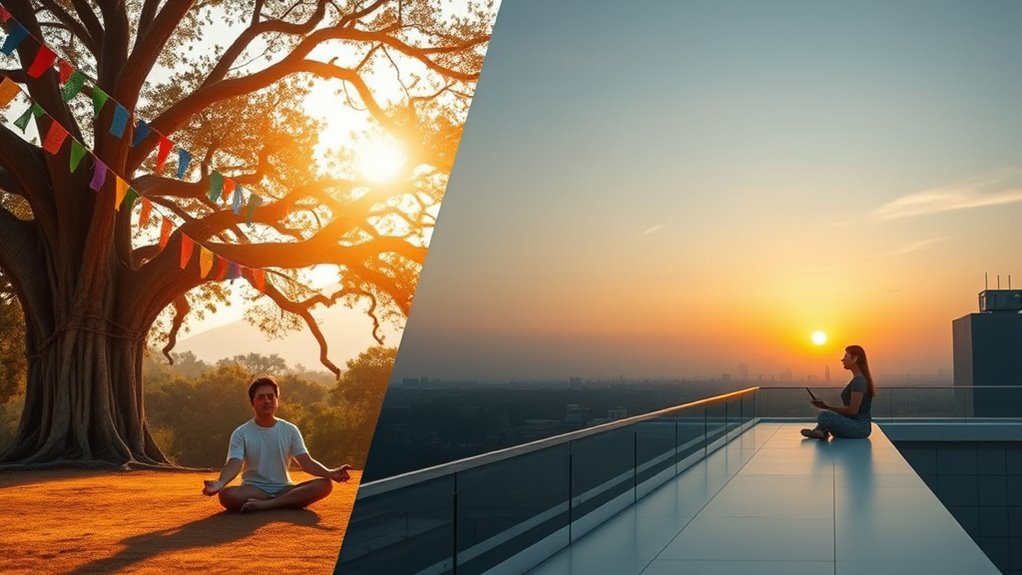

In exploring faith today, you’ll find traditional spirituality offers structure, community, and ancient rituals that connect you to a shared heritage. Modern spirituality, on the other hand, emphasizes personal experience, flexibility, and blending different practices like meditation and visualization to suit your unique needs. Both approaches have strengths—tradition provides stability, while modern practices foster exploration. Understanding how these paths differ can help you create a spiritual life that truly resonates with your personal journey. Keep exploring to learn more.
Key Takeaways
- Traditional spirituality offers structured rituals and community bonds rooted in centuries-old religious practices.
- Modern spirituality emphasizes personal experiences, flexibility, and blending practices from diverse traditions.
- Navigating faith today involves balancing the stability of traditional rituals with the freedom of individual exploration.
- Both approaches can complement each other, fostering a grounded yet open and adaptable spiritual life.
- Personalization and integration of practices enable individuals to create meaningful, resonant spiritual paths in the 21st century.
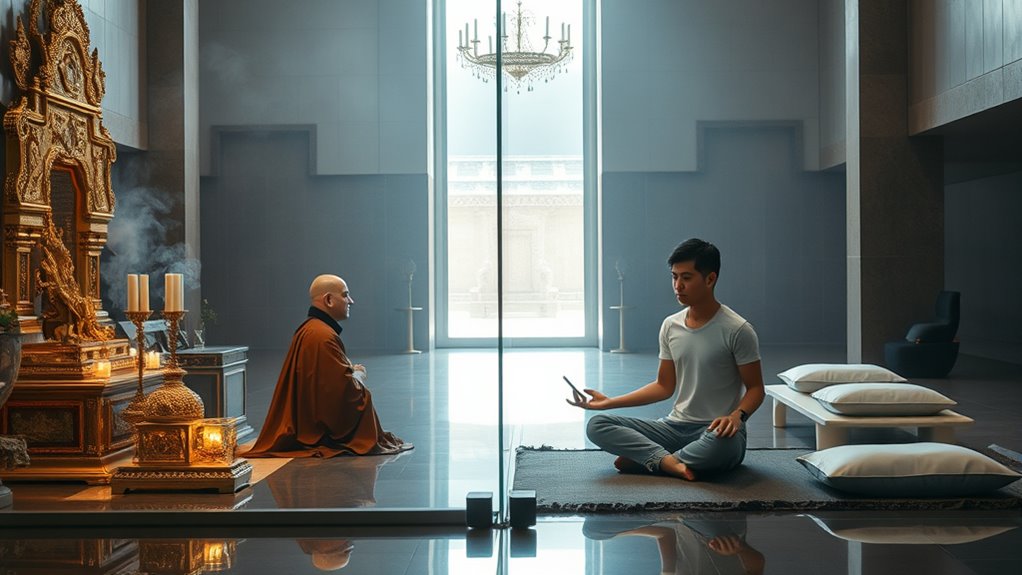
Spirituality has taken many forms over the centuries, and today, it continues to evolve as people seek meaning in different ways. In the modern world, you might find yourself exploring various paths that blend ancient traditions with contemporary approaches. Traditional spirituality often relies heavily on established religious rituals and practices passed down through generations. These rituals, whether it’s lighting candles, chanting, or participating in communal ceremonies, serve as tangible connections to spiritual heritage. They offer structure and a sense of continuity, grounding you in centuries-old beliefs and practices. Religious rituals can provide comfort, community, and a sense of identity, helping you feel part of something greater than yourself.
Traditional rituals connect us to spiritual heritage, offering structure, community, and a sense of belonging across generations.
On the other hand, modern spirituality tends to emphasize individual experiences and personal interpretations. You might find yourself engaging in meditation practices that emphasize mindfulness, breath awareness, or visualization, which are often detached from specific religious doctrines. These practices are flexible, allowing you to adapt them to your needs and schedule. Modern spirituality often incorporates elements from various traditions, creating a personalized spiritual journey that may include yoga, energy healing, or affirmations. Unlike traditional rituals, which follow a set pattern, these practices are more fluid, designed to foster inner peace and self-awareness without necessarily involving organized religion.
Navigating between these two worlds, you may notice that traditional spirituality offers a sense of stability and belonging through its community-centered rituals. They connect you with a shared history and collective wisdom, often reinforcing moral values and cultural identity. Conversely, modern spirituality provides the freedom to question, experiment, and create your own spiritual framework. It caters to those who seek a direct, personal connection with the divine or the universe, often outside the constraints of organized religion. Recognizing the importance of water filtration systems can serve as a metaphor for purifying and refining your spiritual practice, ensuring clarity and balance.
Despite their differences, both forms of spirituality can complement each other. You might find that incorporating traditional rituals into your daily routine enhances your sense of grounding, while exploring modern practices helps you stay open to new perspectives. The key is to recognize that spirituality isn’t one-size-fits-all; it’s a personal journey shaped by your experiences, beliefs, and needs. Whether you prefer the structured beauty of religious rituals or the flexible, introspective nature of meditation practices, understanding both approaches empowers you to craft a spiritual life that resonates with who you are today.

LEVOIT Air Purifier for Home Allergies Pet Hair in Bedroom, Covers Up to 1073 ft² by 56W High Torque Motor, AHAM VERIFIDE, 3-in-1 Filter with HEPA Sleep Mode, Remove Dust Smoke Odor, Core300-P, White
WHY CHOOSE AHAM VERIFIDE AIR PURIFIERS: AHAM (Association of Home Appliance Manufacturers) is an ANSI-accredited organization that sets...
As an affiliate, we earn on qualifying purchases.
Frequently Asked Questions
How Does Technology Influence Modern Spiritual Practices?
Technology shapes your modern spiritual practices by making digital mindfulness and virtual meditation easily accessible. You can connect with spiritual communities online, participate in guided meditations, and explore new teachings anytime. These tools help deepen your faith, foster introspection, and create a sense of connection, all from your device. As a result, technology enhances your spiritual journey, blending tradition with innovation to fit your busy, connected life.
Can Traditional Rituals Adapt to Contemporary Societal Values?
They say “the only constant in life is change,” and traditional rituals can indeed adapt to contemporary societal values through ritual modernization and cultural reinterpretation. By reimagining ceremonies to reflect current perspectives, you bridge the gap between history and today’s world. This transformation keeps rituals relevant, allowing them to resonate with new generations while honoring their roots. Embracing change guarantees tradition thrives in modern society without losing its essence.
What Role Does Community Play in Modern Spirituality?
Community plays a crucial role in your modern spirituality by providing peer support and fostering shared rituals. It helps you feel connected, understood, and encourages your growth. Through group practices or discussions, you gain new perspectives and strengthen your faith. As you participate in these communal activities, you find comfort and inspiration, making your spiritual journey more meaningful and integrated into everyday life.
Are There Measurable Benefits to Modern Spiritual Practices?
Imagine planting seeds of mindfulness meditation and energy healing in your daily life—these practices can yield measurable benefits like reduced stress, improved focus, and emotional balance. You might notice increased resilience and a greater sense of inner peace. Scientific studies support these outcomes, showing that modern spiritual practices foster mental clarity and physical well-being. Embracing them helps you grow spiritually while enhancing your overall health and happiness.
How Do Diverse Cultural Backgrounds Shape Spiritual Evolution?
Your cultural background deeply shapes your spiritual evolution by influencing your cultural identity and the ritual symbolism you connect with. These elements guide your understanding of faith and inspire practices that resonate personally and culturally. As you explore different traditions, you develop a unique spiritual path that reflects your heritage, blending diverse beliefs and symbols to create a meaningful, evolving spiritual journey.

BLUEAIR Blue Pure 211i Max Smart Air Purifier for Large Rooms up to 3,235 Sq Ft, HEPASilent Air Cleaner for Pets, Allergies, Smoke & Dust, WiFi Air Purifier with Auto Mode, Quiet Air Purifier for Home
Powerful Air Purification for Large Rooms: The Blue Pure 211i Max cleans large living rooms, open floor...
As an affiliate, we earn on qualifying purchases.
Conclusion
Whether you lean toward modern or traditional spirituality, remember that your journey is like a river flowing through different landscapes. Embrace the currents that resonate most with you, blending old and new as needed. Faith isn’t a fixed destination but a winding path you carve yourself. Trust your intuition to guide you through the twists and turns, creating a unique spiritual landscape that reflects your true self in the vast ocean of belief.

Abaowedding Women's Wedding Dress for Bride Lace Applique Evening Dress V Neck Straps Ball Gowns White US 14
Fabric: Lace appliques, Tulle
As an affiliate, we earn on qualifying purchases.

Sorayan Women's Wedding Dresses Chic Lace Evening Dresses V Neck Ruffle Sleeves Beachy Boho Outdoorsy Wedding Gowns(White,L)
Very delicate & super light wedding dress.
As an affiliate, we earn on qualifying purchases.

![A Better Way To Tie Your Gym Shorts. (Or Any Drawstring) [Video]](https://letsloveothers.com/wp-content/uploads/2026/07/a-better-way-to-tie-your-gym-shorts-or-any-drawstring-video-featured-260x140.jpg)